H.R. 5 Passed the House 224–206. The Senate Never Voted.
The Equality Act would have extended federal civil-rights protections to sexual orientation and gender identity across six domains of American life. It passed one chamber and stalled.
Legislative record
- Bill designationH.R. 5, 117th Congress
- House vote224–206, 25 February 2021
- Senate outcomeno floor vote; died at close of 117th Congress, January 2023
- Votes required for Senate cloture60
H.R. 5 Passed the House 224–206. The Senate Never Voted.
Photo: United States Capitol, Washington, D.C. Principle floor plan, vestibule, library & senate chamber, House of Representatives LCCN2001697320 · Wikimedia CommonsWhat H.R. 5 Would Have Done, and What Happened Instead
The Equality Act, introduced in the 117th Congress as H.R. 5, proposed amending the Civil Rights Act of 1964 to add sexual orientation and gender identity as protected characteristics. The bill's reach was deliberately broad: public accommodations, housing, credit, education, federal funding and jury service would all have carried explicit nondiscrimination protections on those grounds. No such statute exists at the federal level.
The House passed the measure on 25 February 2021 by a vote of 224 to 206 ↗, with three Republicans joining a unified Democratic caucus. The Senate, where sixty votes were required to advance the bill past procedural challenge, held no floor vote. The 117th Congress ended in January 2023 without enactment.
The enrolled text as it went to signature, carrying both the repeal and the Senate amendment.
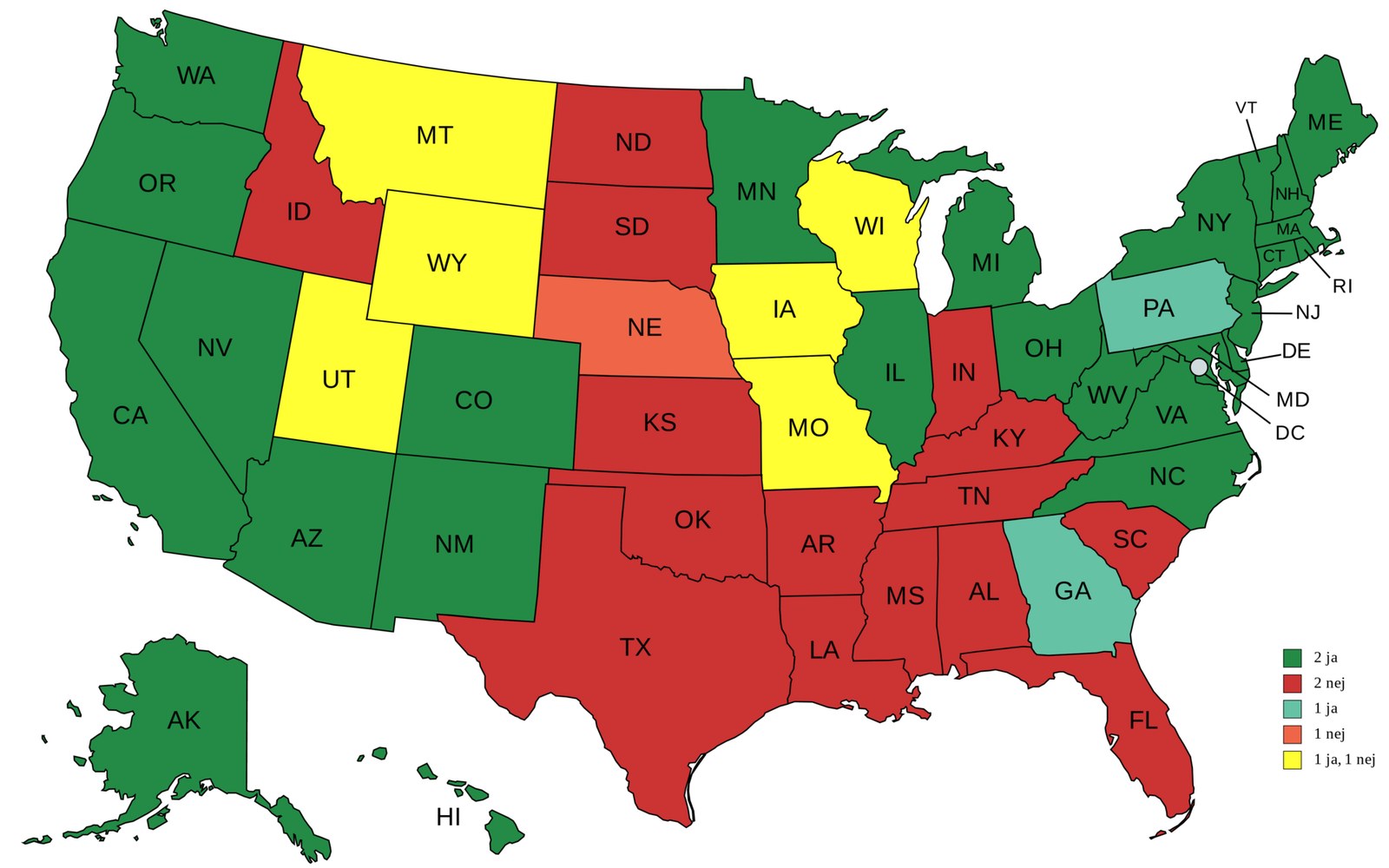
Photo: Respect for Marriage Act Senate Map · Wikimedia CommonsThe gap the Equality Act aimed to fill remains largely in place. In Bostock v. Clayton County, 590 U.S. 644 (2020), the Supreme Court held that Title VII's prohibition on sex discrimination covers discrimination based on sexual orientation and transgender status ↗ — but the ruling was narrow in two distinct ways. First, it reached only employment. Public accommodations, housing, education and credit were untouched. Second, the majority opinion, written by Justice Neil Gorsuch, rested entirely on statutory interpretation of existing text; it did not establish a constitutional right or amend the Civil Rights Act itself. Congress could in principle modify Title VII to undo Bostock's reading, just as Congress could have codified and extended it through H.R. 5.
The distinction matters: a judicial construction of a statute occupies a different legal plane from an enacted amendment. The Williams Institute at UCLA School of Law estimated, as of 2021, that more than half of LGBTQ adults in the United States lived in states without comprehensive state-level protections — making federal action the relevant variable. H.R. 5 was that action. It has not become law.

Sixty-one votes.
Photo: Former Senate Chamber, Alabama State Capitol, as Seen From Gallery 20160713 1 · Wikimedia Commons