Title VII and Title IX After Bostock: What the Agencies Issued
Federal agencies moved quickly to translate the Court's reasoning into binding rules — and federal courts moved almost as quickly to challenge them
Chronology of agency actions
- June 2021EEOC updates technical assistance guidance post-Bostock
- July 2022Department of Education publishes proposed Title IX rule (ED-2021-OCR-0166)
- April 2024EEOC publishes final harassment rule (EEOC-2022-0021), effective 18 June 2024
- 29 April 2024Department of Education publishes final Title IX rule, effective 1 August 2024
- Summer 2024Preliminary injunctions block both rules in multiple states
Title VII and Title IX After Bostock: What the Agencies Issued
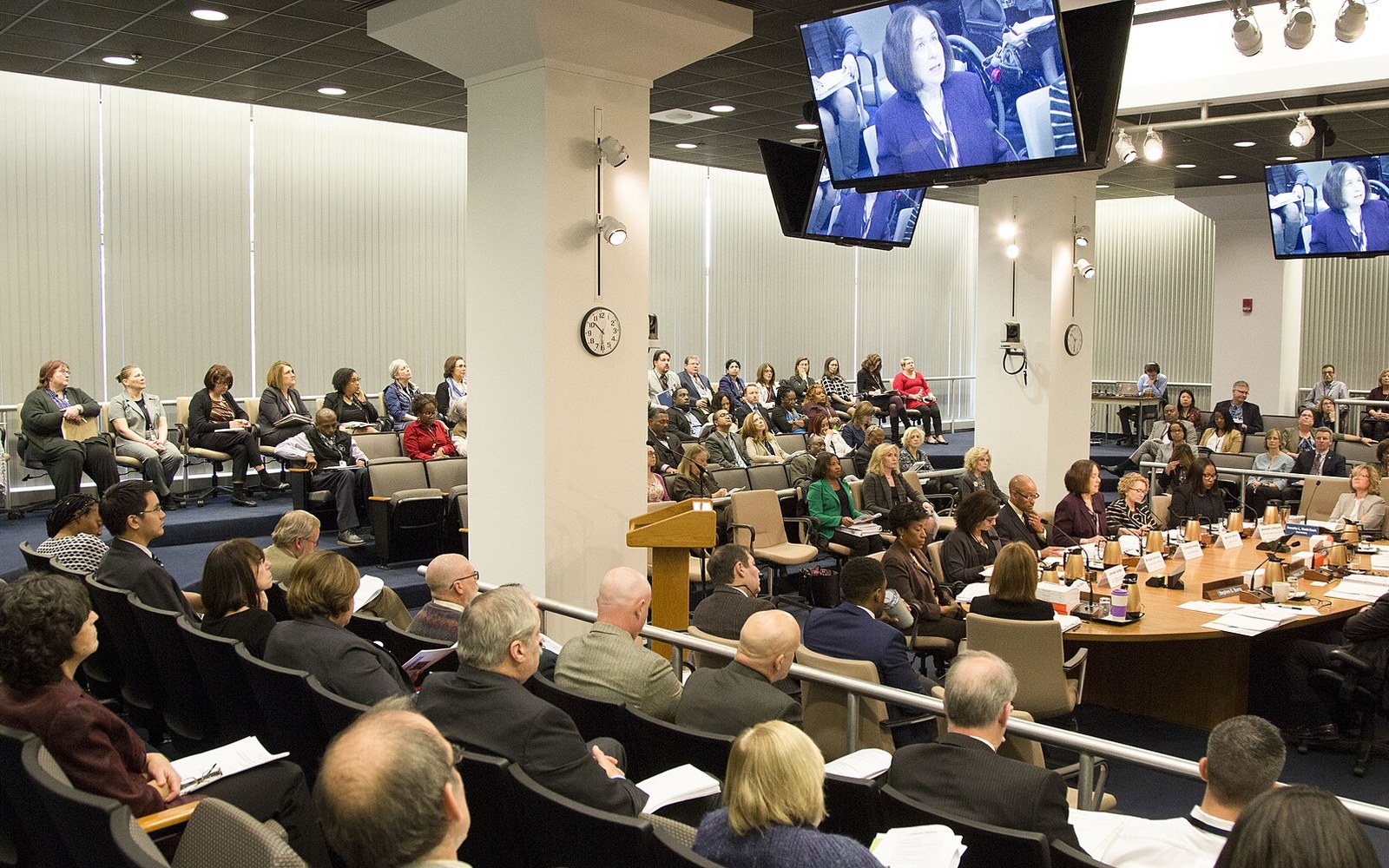
Photo: Equal Employment Opportunity Commission Briefing · Wikimedia CommonsBostock v. Clayton County, 590 U.S. 644 (2020) held on 15 June 2020 that Title VII's prohibition on sex discrimination covers discrimination based on sexual orientation and gender identity. The Supreme Court's reasoning — that an employer who fires a gay or transgender employee necessarily treats that employee differently because of sex — did not itself extend to Title IX, to healthcare, or to any other federal statute. That translation fell to the agencies.
EEOC: Guidance and the 2024 Rule
The Equal Employment Opportunity Commission had already taken the position, in its 2015 decision in Baldwin v. Foxx, that Title VII reached sexual orientation. After Bostock confirmed that reading and extended it to gender identity, the EEOC updated its technical assistance guidance in June 2021 to reflect the holding. That document, while not a binding regulation, instructed employers that harassment or adverse action based on gender identity constituted unlawful sex discrimination cognizable under Title VII.

Sixty-one votes.
Photo: Former Senate Chamber, Alabama State Capitol, as Seen From Gallery 20160713 1 · Wikimedia CommonsThe Commission then moved to rulemaking. In April 2024 the EEOC published final enforcement guidance on harassment in the workplace, dated 29 April 2024, setting out that harassment based on gender identity — including refusal to use an employee's stated name and pronouns — falls within Title VII's prohibition. Within weeks of the effective date, courts in Texas and Louisiana issued preliminary injunctions blocking enforcement of portions of the rule, with judges finding that the challengers had raised substantial questions about whether the EEOC's construction exceeded the agency's authority. As of mid-2025, the injunctions remained in place in those jurisdictions pending further litigation.
Department of Education: The 2022 Proposal and the 2024 Final Rule
The U.S. Department of Education's path was longer. Title IX of the Education Amendments of 1972 bars sex discrimination in any education program receiving federal financial assistance. The Department issued a notice of proposed rulemaking in July 2022 (docket number ED-2021-OCR-0166), arguing that Bostock's textual logic applied with equal force to the word "sex" in Title IX and that gender identity discrimination was therefore covered.
The final rule ↗ was published 29 April 2024, with an effective date of 1 August 2024. It amended 34 C.F.R. Part 106, specifying that a recipient of federal funds may not discriminate against students or employees on the basis of sex stereotyping, sex characteristics, or gender identity. A separate provision addressed the procedural rights of complainants in sexual-misconduct proceedings.
Litigation was immediate and extensive. Courts in at least six states — including Louisiana, Kentucky and Tennessee — granted preliminary injunctions before the effective date, blocking the rule within those states. The United States District Court for the Eastern District of Kentucky held that the rule likely exceeded statutory authority insofar as it required schools to recognize gender identity in contexts the plaintiff states argued the text did not reach. Other courts, ruling on narrower challenges, left portions of the rule in effect. The Supreme Court declined an emergency application to reinstate the rule nationwide, leaving the patchwork of injunctions in place through the remainder of 2024.
Scope and What Remains Unsettled
Both agencies acted on the premise that the statutory word "sex," as interpreted in Bostock, reaches gender identity throughout federal civil-rights law. The courts that issued preliminary injunctions did not uniformly dispute that premise; some focused instead on procedural objections — whether the agencies had followed notice-and-comment requirements correctly — or on specific provisions, such as rules governing bathroom access, that they found lacked adequate statutory grounding.
The EEOC's enforcement guidance and the Department of Education's amended regulation represent the fullest administrative articulation to date of Bostock's implications outside employment. Whether those implications survive further appellate review, and whether a future administration will maintain the rules in their current form, remains an open question before the courts.

The bound volumes are the citation: a holding exists at a page number, and that page number is how every later court reaches it.
Photo: Christian Wasserfallen / Pexels