United States v. Skrmetti (2025): What the Court Held, and What It Left to the States
The Supreme Court upheld Tennessee's ban on gender-affirming medical care for minors, ruling six to three that the law survives equal-protection scrutiny — and declining to say how far that conclusion extends.
The statute's structure
- Tennessee SB 1 (2023)codified at Tenn. Code Ann. § 68-33-101 et seq.; prohibits gender-transition care for minors
- The statute's key distinctionpurpose of treatment (gender transition vs. other diagnosis), not sex of patient
- Same medicationspermitted for non-transition diagnoses; barred only when the clinical purpose is gender affirmation
The Statute and the Circuit Below
Tennessee's Senate Bill 1 (SB 1), enacted in March 2023 and codified at Tennessee Code Annotated § 68-33-101 et seq., prohibits healthcare providers from administering puberty blockers or cross-sex hormones to minors for the purpose of "gender transition" — defined in the statute as any treatment intended to alter the minor's "appearance or function" so as to conform to a gender identity inconsistent with the minor's sex at birth. Surgical procedures for the same purpose were separately addressed and similarly barred. The statute expressly preserves the same medications when prescribed for conditions other than gender transition, meaning a minor may receive testosterone for delayed puberty caused by a clinical diagnosis but not to affirm a transgender identity. Civil and criminal penalties attach to violations.
The United States brought suit in the Middle District of Tennessee, joined by individual plaintiffs including L.W. and her parents, challenging SB 1 under the Equal Protection Clause of the Fourteenth Amendment. The District Court entered a preliminary injunction. A divided panel of the United States Court of Appeals for the Sixth Circuit reversed in September 2023, holding that Tennessee's SB 1 ↗ classified on the basis of the medical purpose of treatment rather than the sex of the patient, and that rational basis review applied and was satisfied. The Sixth Circuit's reasoning drew an analogy to the statute's structure: because the restriction turns on the intended outcome of treatment rather than who receives it, no facial sex classification existed in the panel majority's view. The Supreme Court granted certiorari to resolve the constitutional question.

Christopher Street, part of a National Monument since 24 June 2016.
Photo: Stonewall Inn with Orlando nightclub shooting memorial during Pride 2016 (50126p) · Wikimedia CommonsThe Holding
The Court decided United States v. Skrmetti on 18 June 2025, affirming the Sixth Circuit by a vote of six to three. Chief Justice John Roberts wrote for the majority, joined by Justices Thomas, Alito, Gorsuch, Kavanaugh, and Barrett. The majority held that SB 1 does not on its face classify on the basis of sex within the meaning of the Equal Protection Clause, and that rational basis review — the least demanding level of constitutional scrutiny, requiring only that the law bear a plausible relationship to a legitimate government interest — is the appropriate standard. Applying that standard, the majority held the statute constitutional: Tennessee's articulated interests in protecting minors from treatments the legislature found to be of uncertain safety and efficacy, and in maintaining the existing regulatory scope of medical practice for this population, supplied a rational basis sufficient to sustain the law.
The majority's textual analysis concentrated on how the statute itself is written. SB 1 draws its operative distinction between gender-transition care and other care, not between male patients and female patients. A minor of either sex may receive the identical pharmaceutical compound — the statute's restriction depends entirely on the purpose for which the prescription is written. Because the statute does not, on its face, distribute benefits or burdens according to the patient's sex, the majority concluded that no sex-based classification triggering heightened scrutiny was present. The majority expressly declined to address whether a law that applied different rules to boys and girls would demand a different analysis, leaving that question for future cases.
The Dissents
Justice Sonia Sotomayor dissented, joined by Justice Jackson and, in part, by Justice Kagan, in an opinion that contested the majority's framing at every level. The dissent argued that SB 1 is sex-based on its face: the statute's operative definition of gender transition is tethered entirely to whether a treatment aligns with the minor's "sex at birth," a term that makes the sex of the patient the explicit determinant of what care is lawful. On the dissent's reading, a transgender boy who receives testosterone for gender-affirming purposes is treated differently from a non-transgender girl who receives the same drug for the same physiological effect because of the boy's sex at birth — a classification the dissent characterised as textbook sex discrimination requiring at minimum intermediate scrutiny. Under intermediate scrutiny, the dissent contended, the record assembled below did not establish that SB 1 was substantially related to an important government interest, and the statute should have fallen.
Justice Kagan filed a separate dissent emphasising what she described as the majority's departure from the Court's prior equal-protection cases involving sex-based classifications, and questioning whether a purpose-based framing can insulate from heightened review a statute whose operative trigger is, in every application, the patient's natal sex.
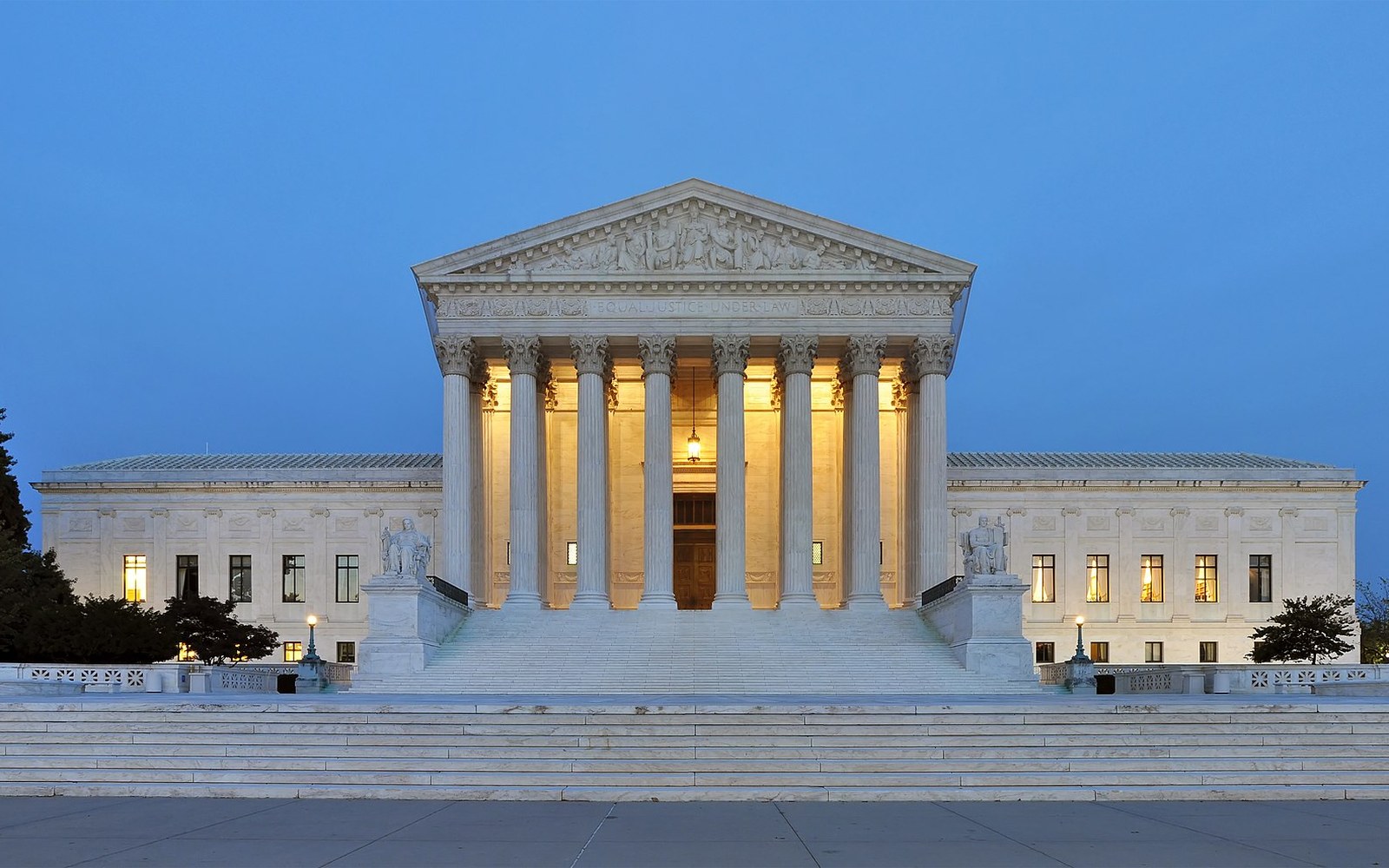
Nine votes, and the building they are counted in.
Photo: Panorama of United States Supreme Court Building at Dusk · Wikimedia CommonsScope and What the Decision Leaves Open
The Court's holding is narrow in a precise technical sense. It addresses only the equal-protection question raised on the record as presented, and only as applied to the specific statutory structure of SB 1. The majority opinion does not resolve whether the Constitution imposes any limit on state authority over gender-affirming care for adults; it takes no position on whether a differently structured statute, one that explicitly distinguished between male and female patients, would survive sex-discrimination analysis; and it expresses no view on questions arising under the substantive due process doctrine, which the plaintiffs did not press as their primary theory.
The practical scope, however, is significant. By the time of the decision, more than twenty states ↗ had enacted legislation restricting gender-affirming care for minors in terms broadly analogous to SB 1. The affirmance of SB 1 under rational basis review effectively forecloses equal-protection challenges to statutes of that structure in the federal courts, absent a future Supreme Court decision applying heightened scrutiny to the relevant classification. States with existing bans structured similarly to Tennessee's may enforce them without constitutional impediment under the Skrmetti holding; states that have not acted retain the authority to permit such care, because the decision holds only that the Constitution does not require prohibition — not that it mandates it.
The majority also declined, in a passage that drew attention from commentators, to invoke or distinguish the Court's 2020 decision in Bostock v. Clayton County, 590 U.S. 644, which held under Title VII that employment discrimination against a person for being transgender is discrimination "because of sex." The Skrmetti majority characterised Bostock as a case of statutory interpretation — construing Title VII's text — rather than a constitutional holding, and declined to draw analogies between the statutory analysis there and the constitutional analysis here. That demarcation leaves open whether Bostock's interpretive logic might reach healthcare statutes through some other federal statutory vehicle, a question not presented and not answered in Skrmetti.
Citation and Record
United States v. Skrmetti, 605 U.S. ___ (2025), was argued on 4 December 2024 and decided 18 June 2025. The case arose as No. 23-477 ↗ on the Supreme Court's docket. The affirmance rests on the Sixth Circuit's September 2023 panel decision reversing the district court's preliminary injunction. The vote was six to three, with Chief Justice Roberts writing for the Court and Justice Sotomayor leading the principal dissent.

The bound volumes are the citation: a holding exists at a page number, and that page number is how every later court reaches it.
Photo: Christian Wasserfallen / Pexels